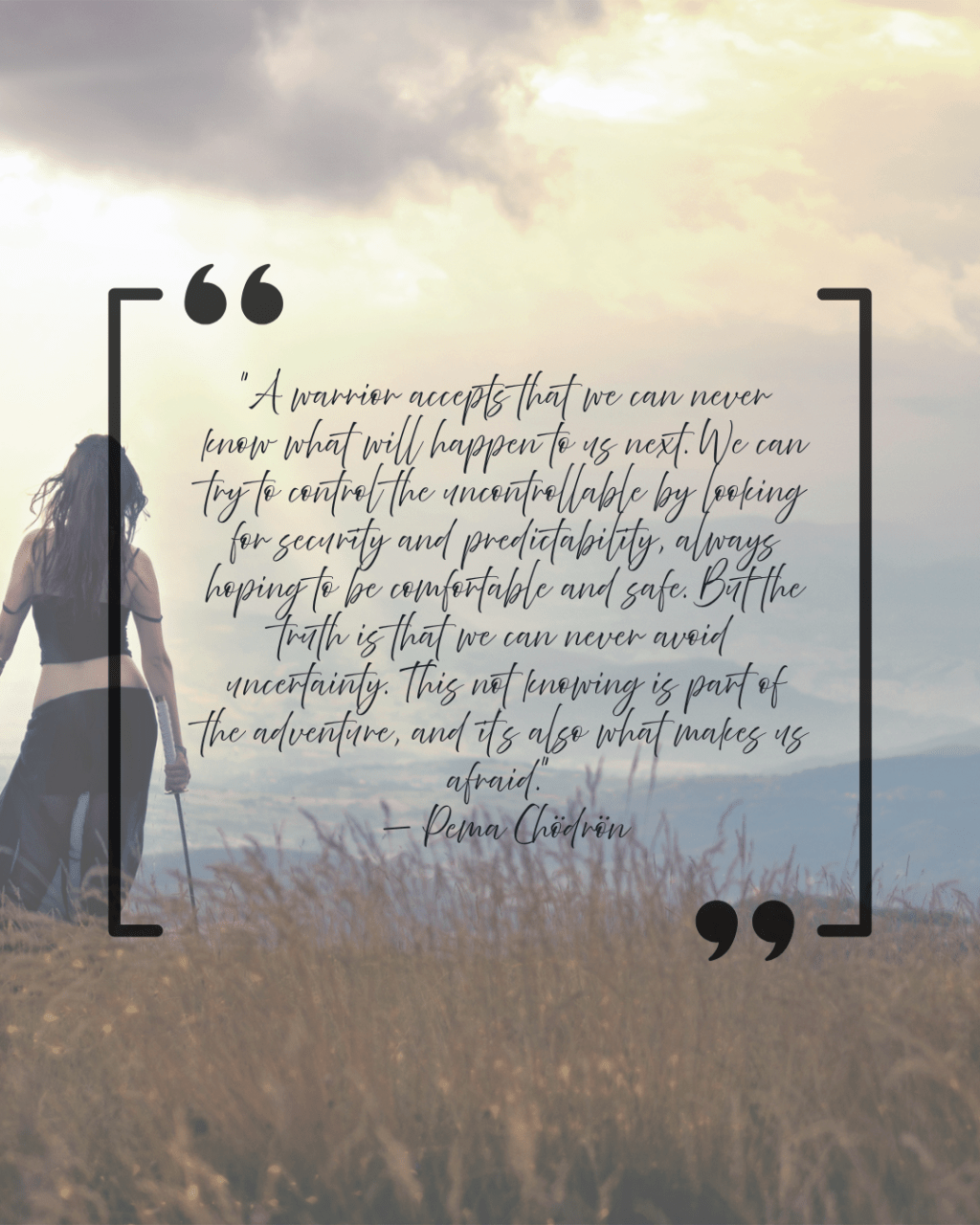
Inspired by the words of Pema Chödrön
“A warrior accepts that we can never know what will happen to us next. We can try to control the uncontrollable by looking for security and predictability, always hoping to be comfortable and safe. But the truth is that we can never avoid uncertainty. This not knowing is part of the adventure, and it’s also what makes us afraid.” — Pema Chödrön
The Unlocked Door
Every morning, the ritual is the same.
Boots laced. Badge pinned. Gear checked. A kiss goodbye—maybe quick, maybe long, maybe one of those that lasts a half-second longer than usual because something quiet inside you says hold on.
And then the door closes.
What happens in the space between that closed door and the moment it opens again, that is where first responder families live. Not in crisis, not in safety, but in the in-between. In the waiting. In the not knowing.
Pema Chödrön, a Buddhist teacher and author, wasn’t writing specifically for the spouse or child of a law enforcement officer. But her words land there with startling precision. Because she is describing, in the language of philosophy and courage, the exact emotional terrain that first responder families navigate every single day.
What It Means to Be a Warrior — and to Love One
When Chödrön uses the word warrior, she doesn’t mean someone who charges into battle without fear. She means something far more demanding: someone who chooses to remain present and open in the face of uncertainty, rather than collapsing inward, shutting down, or pretending the uncertainty isn’t real.
By that definition, first responders are warriors. We already know that.
But here is what often goes unspoken: so are you.
The partner sitting with the phone on the nightstand. The parent explaining to a seven-year-old why Daddy might be late. The teenager who learned to read the room the moment Mom walks in the door. The child who doesn’t quite understand the weight of the uniform, but somehow feels it.
You are warriors too, practicing the same discipline Chödrön describes, not in a fire station or on a patrol route, but in kitchens and school pickups and sleepless 3 a.m. hours when the shift should have ended and hasn’t.
The warrior’s path, she teaches, is not about being fearless. It is about being honest with yourself: I am afraid. And I am here anyway.
The Illusion of the Controlled Life
Read Chödrön’s words again: “We can try to control the uncontrollable by looking for security and predictability, always hoping to be comfortable and safe.”
There is something quietly devastating in that sentence, because it describes something we all do. We build systems to hold the fear at bay. We track the shift schedule compulsively. We fill the hours with busyness so our minds don’t wander to the places they want to go. We tell ourselves: if I know enough, worry enough, prepare enough — I can make this safe.
But the map is not the territory. The schedule is not the guarantee.
Chödrön’s insight is not meant to terrify. It is meant to liberate. Because there is an enormous amount of energy spent in the attempt to control the uncontrollable — energy that could be spent living. Loving. Being present to the life that is actually here, right now, in front of you.
The law enforcement family doesn’t get a life without risk. But they do get a choice about how to inhabit that life: with clenched fists or open hands.
The River Metaphor: Learning to Swim Rather Than Dam
Imagine uncertainty as a river running through your home. It doesn’t stop. It doesn’t negotiate. It just moves.
One approach is to dam it. To pile up sandbags of control, routine, and denial. This takes tremendous effort, and the dam always leaks. When it breaks, the flood is worse for having been held back.
The other approach: the warrior’s approach, is to learn to swim. Not to surrender to drowning, but to develop the skill, the strength, and the trust to move through the current rather than against it. To understand the river’s patterns. To respect its power without being consumed by it.
For first responder families, this looks like building emotional fluency rather than emotional armor. It means developing the capacity to say I don’t know if today will be fine without that sentence becoming a catastrophe. It means teaching children to hold complexity — that their parent does dangerous work and comes home and that both of those truths can live in the same house.
Swimming in the river doesn’t mean you’re not afraid. It means you’ve made peace with the water.
“Part of the Adventure”— The Radical Reframe
This may be the most startling line Chödrön offers: “This not knowing is part of the adventure.”
For a first responder family, that word adventure, can feel almost offensive at first. This isn’t an adventure. This is real. This is our life.
But stay with it.
Every love story is an adventure. Every commitment to another human being is a plunge into the unknown, because people are unknowable in the fullest sense, and life is not a controlled experiment. What makes a first responder family’s adventure distinct is only that the stakes are named out loud. The risk is visible. The uniform makes it impossible to pretend otherwise.
But here is the gift hidden in that visibility: you can’t sleepwalk through it.
Families who live with uncertainty tend to be more intentional about the time they have. The dinner table matters more. The phone call on the way home matters more. The ordinary Tuesday evening where nothing happens, where the whole family is briefly, completely together—carries a weight of gratitude that other families may never quite feel.
Chödrön is suggesting that the not-knowing, rather than being the enemy of a good life, might actually be one of its animating forces. The thing that keeps you awake to what you have.
Fear Is Not the Opposite of Love — It Is Its Shadow
“It’s also what makes us afraid.”
She doesn’t flinch from this. The not-knowing that makes life an adventure is the same not-knowing that curls in your chest at 2 a.m. These are not two different things. They are one thing, seen from two directions.
This is worth sitting with, because our culture tends to treat fear as a problem to be solved — a weakness to overcome, a signal that something has gone wrong. But for first responder families, fear is not a malfunction. It is the body and heart doing exactly what they are supposed to do: marking what matters. You are afraid because you love. The fear is the love, wearing a different face.
The warrior’s practice is not to eliminate the fear. It is to stop pretending it isn’t there, and to stop letting it make decisions. Fear can exist in the room without running the room. You can feel it, name it, and still choose presence, connection, and joy in the same breath.
A Practice for the In-Between Hours
Chödrön’s teachings are practical at their core. Here are some ways to live the warrior’s path as a first responder family:
Name what you feel. Not to dwell in it, but because unnamed fear grows in the dark. “I’m anxious today, and that’s okay” is a disarming sentence.
Resist the urge to manage away the uncertainty. Some preparation is wise. Constant monitoring is a way of avoiding the present. Notice the difference.
Make ordinary moments extraordinary through attention. The adventure is happening right now, in the regular evening, in the conversation over dinner. Show up for it.
Talk to your kids honestly, at age-appropriate levels. Children raised in first responder households often become remarkably resilient…but only when the adults around them model honesty and emotional openness, not performed calm.
Find your community. Other first responder families understand this river in a way others may not. That understanding is medicine.
Let the fear be love. When anxiety rises, try reframing it not as a warning that something is wrong, but as evidence of how deeply you are bonded to someone worth being afraid for.
The Door Will Open Again
The door closes in the morning (or night).
And in most stories—in the vast majority of shifts, in the ordinary, sacred, unremarkable way that most days go — the door opens again. The boots come off. The weight is set down. The person you love is, again, in the room with you.
Pema Chödrön is not asking you to stop hoping for safety. She is asking you to stop requiring it as the price of living fully. She is asking whether you might be able to hold both the fear and the love, the uncertainty and the gratitude, the closed door and the faith that it will open — all at once, without needing any of it to be resolved.
That, she says, is the warrior’s path.
And if you are part of a first responder family, you are already walking it, whether you knew it or not.
You are braver than you believe. The river is real, and so is your ability to swim.
If you found this piece meaningful, share it with another first responder family who might need these words today. And check out my book Silent Warriors: The Guardians Behind the Badge.




Leave a comment